
CURRENT ISSUE:
Volume 8 (2025)
For the third year in a row philosophical reflections on AI developments take front stage, with Garland’s Ex Machina and Ishiguro’s Klara and the Sun continuing to ground nuanced reflections about mind, sentience, embodiment and personhood, and anticipating the complex moral issues that may arise in a world in which artificial operators become ubiquitous.
But that is not all: we examine the ethical implications of moral enhancement experiments in Serenity, look at an unconventional approach to the task of the translator in Arrival, and in our new section, Charting the Stars, we explore the impact of the most influential authors and works of SF, beginning with a classic among classics, Jules Verne.
Enjoy your visit!

Editorial Notes
Alfredo Mac Laughlin
- Defining Science Fiction and Fantasy.
- New Section: Charting the Stars. A home for your groundwork research.
- New Section: Letters to the Editor: A Proposal. Let’s make it a philosophical conversation!
General Articles (PEER-REVIEWED)
Do Androids Dream of Electric Sheep? AI Sentience in Ishiguro’s Klara and the Sun
Timothy Christensen
What is it like to be Ava? Minds and Misrecognition in Ex Machina
Kelly Coble
Robbie, Klara, and Ethan: Replicability and the Moral Status of AI
Mark Tunick
Making People Better? Lessons from Serenity on Moral Enhancement
Barbara Stock
Arrival and “The Task of the Translator”
Amresh Sinha
Autonomy Under Control: Ethical Challenges of Brain-Machine Interfaces
Jorge Mateus and Rui Mateus
Charting the Stars (Peer Reviewed) ** New section! **
Jules Verne’s Use of Victorian Scientific Models
Quentin R. Skrabec
Book Reviews
Liz W. Faber
Siobhain Lash
Science Fiction (2021) by Sherryl Vint
Sherry Ginn
R.U.R. and the Vision of Artificial Life (2021) by Jitka Čejková (ed.)
James M. Okapal
Richard L. Bilsker
Previous Issues
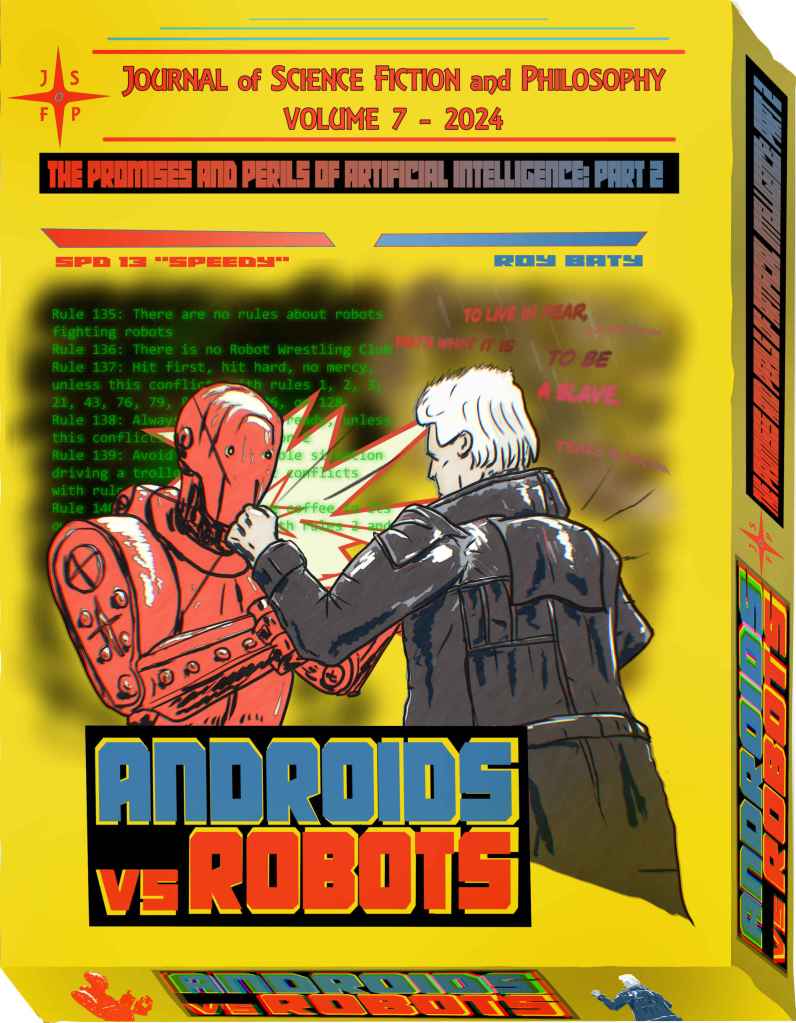
Vol. 7 (2024): The Promises and Perils of Artificial Intelligence, Part 2: Androids Vs Robots!
Science fiction authors have covered all ranges of opinions and possibilities regarding the development of artificially intelligent beings. Robots, supercomputers, cybermen, replicants, even overgrown space probes, these have been envisioned as mindless laborers, loyal sidekicks, menacing overlords, wise saviors, genocidal exterminators, sly impersonators, artificial friends, or as a new form of slave underclass. As we approach the technological capacity to create artifacts that may become performatively indistinguishable from human activity, philosophical questions about them become increasingly urgent, whether it be questions about their being (metaphysical and epistemological), or about their treatment and place in society (ethical and political). In this volume we contrast two different approaches to the future possibilities of AI: the deep, existential questioning of Philip K. Dick against the practical, logical conundrums proposed by Isaac Asimov.
Published: 2024-07-01 (July 1, 2024)
YEARLY THEME (PEER-REVIEWED)
The Trolley Problem and Isaac Asimov’s First Law of
Robotics
Erik Persson and Maria Hedlund
Jack Smyth
Judgement after Automation: Posthumanist Reflections on Asimov’s Laws of Robotics
Claudio Celis Bueno and Steve Jankowski
BOOK REVIEWS
Jessica Roisen
H.G. Wells and the Twenty First Century (2023) by Bill Cooke
Alfredo Mac Laughlin
Vol. 6 (2023): The Promises and Perils of Artificial Intelligence
Science fiction authors have covered all ranges of opinions and possibilities regarding the development of artificially intelligent beings. Robots, supercomputers, cybermen, replicants, even overgrown space probes, these have been envisioned as mindless laborers, loyal sidekicks, menacing overlords, wise saviors, genocidal exterminators, sly impersonators, artificial friends, or as a new form of slave underclass. As we approach the technological capacity to create artifacts that may become performatively indistinguishable from human activity, philosophical questions about them become increasingly urgent, whether it be questions about their being (metaphysical and epistemological), or about their treatment and place in society (ethical and political). Should we think of artificially intelligent beings as objects, tools, servants, saviors, competitors, partners..?
Published: 2023-06-01 (June 1, 2023)

Editor’s Notes
Vol. 6 (2023): The Promises and Perils of Artificial Intelligence
Alfredo Mac Laughlin
YEARLY THEME (PEER-REVIEWED)
Disentangling Human Nature from Moral Status: Lessons For and From Philip K. Dick
James Okapal
Transcendence: Measuring Intelligence
Marten Kaas
General Articles (Peer-Reviewed)
Demiurge and Deity: The Cosmical Theology of Olaf Stapledon’s Star Maker
Joshua Hall
The Desire for Immortality: The Posthuman Bodies in Ken Liu’s The Waves
Junge Dou
Andrew Fiala
Stephen S. Hanson
Vol. 5 (2022)
Published: 2022-06-15 (June 15, 2022)

Editor’s Notes
Alfredo Mac Laughlin
General Articles (Peer-Reviewed)
The Politics of Truth in China: Ontological-Ethical Dimensions of Science and Science Fiction
Lennon Zhang
Children of the Mind and the Concept of Edge and Center Nations
Steven Foertsch
Ex Machina: Testing Machines for Consciousness and Socio-Relational Machine Ethics
Harrison S. Jackson
The Morality of Artificial Friends in Ishiguro’s Klara and the Sun
Jakob Stenseke
A Grammar in Two Dimensions: The Temporal Mechanics of Arrival and the Semantics/Pragmatics Divide
A.G. Holdier
Jaws Within Jaws: A Cosmopolitical Ecology of Alien
Eric Macedo
Conscientious Utilitarianism; or, the Utilitarians Who Walk Away from Omelas
Andrew Dennis Bassford
BOOK REVIEWS
Stefano Bigliardi
Vol. 4 (2021): The Day that Coronavirus Stopped the Earth! What Do We Learn About Pandemics in Science Fiction Stories?
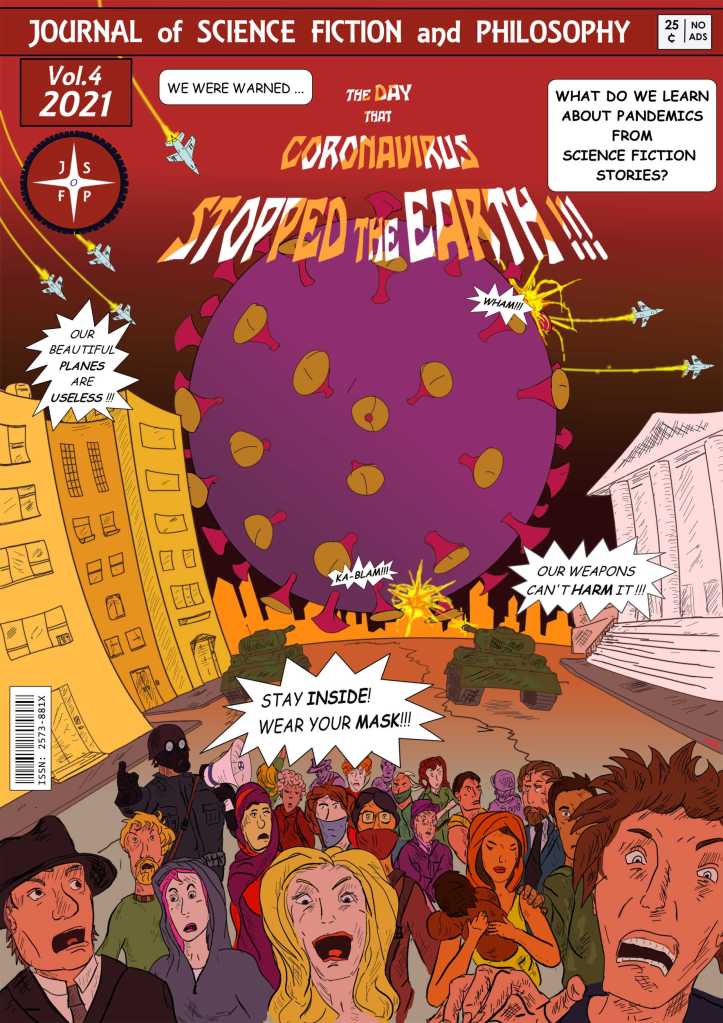
For nearly two centuries science fiction authors have been playing around with an enormous variety of pandemic scenarios. While some stories focus on attempts to avert them, many explore their catastrophic consequences, or the plight of victims and survivors in-between, and the ways in which the most trivial daily routines and the simple facts of life we take for granted may be critically, perhaps permanently disrupted. From eerily prophetic accounts of origin and spread (Stephen Soderbergh’s Contagion) to post-apocalyptic tales of heart-wrenching loneliness (Francis Lawrence’s I Am Legend), SF stories anticipate the plight that humanity is facing during the COVID pandemic. This volume invites us to reflect on the lessons from science fiction stories, and how they help us illuminate philosophically our present times.
Published: 2021-06-01 (June 1, 2021)
Editor’s Notes
Volume 4 (2021): The Day that Coronavirus Stopped the Earth!
Alfredo Mac Laughlin
Yearly Theme (Peer-Reviewed)
I Am Legend as Philosophy: Imagination in Times of Pandemic… A Mutation towards a “Second Reality”?
Rachad Elidrissi
Fatemeh Savaedi and Maryam Alavi Nia
Fiachra O’Brolcháin and Pat Brereton
General Articles (Peer-Reviewed)
“What is my purpose?” Artificial Sentience Having an Existential Crisis in Rick and Morty
Alexander Maxwell
Is Alex Redeemable? A Clockwork Orange as a Philosophical-Literary Platonic Fable
Jones Irwin
Book Reviews
Anna Campbell

The Blue Pill Dilemma: Is Knowledge a Blessing or a Curse?
Vol 3 (2020)
The question about choosing between harsh truths or willful ignorance is as old as Plato’s Cave; older perhaps, down to the Tree of Good and Evil. Science Fiction writers can be as illuminating as they can be ambiguous. In the original Matrix Neo took the Red Pill, choosing Truth – and got himself into a world of trouble. Wouldn’t the Blue Pill (of “Ignorance is Bliss”) have served him better? This volume examines the double-edged quality of knowledge, as explored in a variety of SF scenarios. Can a truth cause more harm than a lie? Can we live in self-deception? Is there a danger of knowing too much? Is knowledge something inherently good, worth seeking for its own sake, is it just a neutral tool, or is it, perhaps, something better left alone?
EDITORIAL NOTES
Editor’s Notes: The Blue Pill Dilemma
Alfredo Mac Laughlin
Yearly Theme (Peer-Reviewed)
Eternal Sunshine of the Spotless Mind, Memory Erasure, and the Problem of Personal Identity
Giorgina Samira Paiella
Towards a Biological Explanation of Sin in Walter M. Miller, Jr.’s A Canticle for Leibowitz
Christopher Ketcham
Solving the Contact Paradox: Rational Belief in the Teeth of the Evidence
Thomas Vinci
Subversion and the Sapir-Whorf Hypothesis in Contemporary Science Fiction
Can Koparan
General Articles (Peer-Reviewed)
Ursula K. Le Guin’s Science Fictional Feminist Daoism
Ethan Mills
Book Reviews
Planet of the Apes and Philosophy: Great Apes Think Alike. (Open Court, 2013)
Stefano Bigliardi
Dune and Philosophy: Weirding the Way of the Mentat. (Open Court, 2011)
Brittany Caroline Speller
Science Fiction and Philosophy: From Time Travel to Superintelligence. (Wiley-Blackwell, 2016)
Stefano Bigliardi
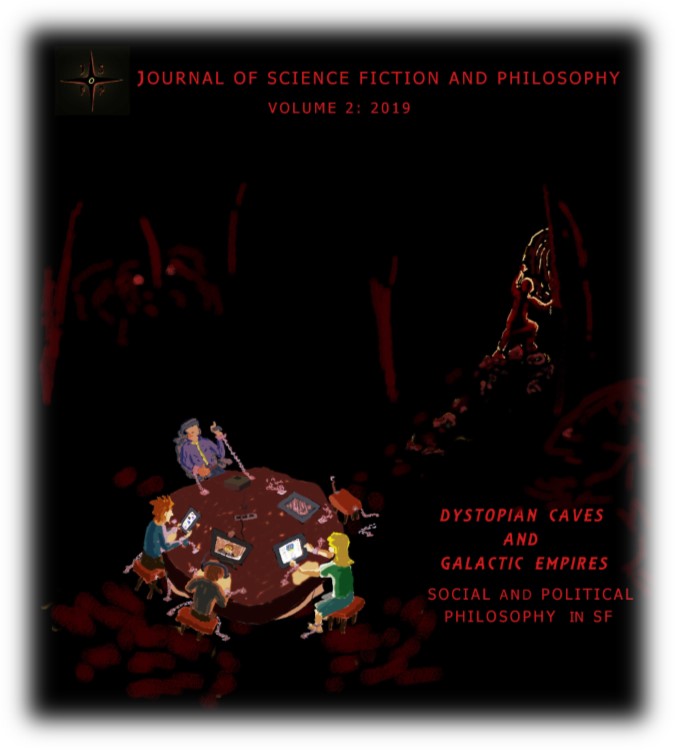
Dystopian Caves and Galactic Empires: Social and Political Philosophy in SF Stories
Vol 2 (2019)
One of the main roles of science fiction has been to warn us (sometimes humorously, sometimes through grim pessimism) of looming social dangers, the product of particular ideas, technologies or social trends. Just how powerful these warnings can be in the public’s imagination may be gauged by the ubiquity of the expression “Big Brother” in political reflection. Occasionally, too, SF has been used to propose somewhat utopian forms of organization. The goal of our 2019 Yearly Theme is to promote a critical discussion of these themes.
Editorial Notes
Editor’s Notes Time, Tenacity and Technophobia
Alfredo Mac Laughlin
Yearly Theme (Peer-Reviewed)
Living in a Marxist Sci-Fi World: A Phenomenological Analysis of the Power of Science Fiction.
Matías Graffigna
Political Myths in Plato and Asimov
Nathaniel Goldberg
General Articles (Peer-Reviewed)
Gallifrey Falls No More: Doctor Who’s Ontology of Time
Kevin S. Decker
Stefano Bigliardi

All Persons Great and Small: The Notion of Personhood in SF
Vol 1 (2018)
SF stories are in a unique position to help us examine the concept of personhood, by making the human world engage with a bewildering variety of beings with person-like qualities – aliens of bizarre shapes and customs, artificial constructs conflicted about their artificiality, planetary-wide intelligences, collective minds, and the list goes on. Every one of these instances provides the opportunity to reflect on specific aspects of the notion of personhood, such as, for example: What is a person? What are its defining qualities? What is the connection between personhood and morality, identity, rationality, basic (“human?”) rights? What patterns do SF authors identify when describing the oppression of one group of persons by another, and how do they reflect past and present human history?
Editorial Notes
Alfredo Mac Laughlin
Yearly Theme (Peer-Reviewed)
Aesthetics in Mary Shelley’s Frankenstein
Jerold J. Abrams
Moreau’s Law in “The Island of Doctor Moreau” in Light of Kant’s Reciprocity Thesis
Dan Paul Dal Monte
Carving a Life from Legacy: Free Will and Manipulation in Greg Egan’s “Reasons to Be Cheerful”
Taylor W. Cyr
Persons and a Metaphysics of the Navel
Dennis M. Weiss
The Creolizing Genre of SF and the Nightmare of Whiteness in John W. Campbell’s “Who Goes There?”
Bernabe S. Mendoza
The Education Station: Teaching with SF
James Rocha
— Teaching Firefly: Companion Material. A Class Schedule for a Course on Joss Whedon and Philosophy
James Rocha
Book Reviews
Westworld and Philosophy: If You Go Looking for the Truth Get the Whole Thing
Stefano Bigliardi
 Journal of Science Fiction and Philosophy
You must be logged in to post a comment.