
Editor’s Notes: Volume 4: The Day that Coronavirus Stopped the Earth!
Works of Science Fiction and Fantasy often portray unsuspecting characters that must reshape their lives, their daily routines and their entire world view when the outlandish, the fantastic or the otherworldly makes an appearance. Often we read and watch these stories with a bit of annoyance at the characters’ surprise, at their difficulties attempting to adjust their world view to the bigger realities that are obviously taking place. Have these characters never watched a science fiction movie? And yet we readers do not expect, nor do we seriously believe, that similar revelations could come our way. Those things happen in books and in the movies! We are not in a book or in a movie…are we?
It was tempting to think so during some of the eeriest moments of 2021, giving lessons on little screens from an office in a ghost campus to students some quarantined a block away, some sitting by the beach in a different hemisphere, while receiving reports of broken supply chains, politicians breaking bubbles, riots over mask mandates and wildlife returning to silent cities.
And yet, I personally felt that science fiction had not been a bad training for this kind of situation. For nearly two centuries SF authors have been playing around with an enormous variety of pandemic scenarios. While some of their stories focused on attempts to avert them, many explored their consequences, from the sad and tragic plight of victims and survivors to the ways in which the most trivial daily routines and assumptions could be critically disrupted.
Thus the Yearly Theme of Volume 4, which aims at reflecting on how science fiction stories can help us illuminate philosophically these strange and difficult times.
For many, one of the most difficult aspects of the pandemic has been the need to isolate, and the difficulties meeting or even seeing other people. Loneliness is poignantly depicted in Francis Lawrence’s I Am Legend. Rachad Elidrissi (“I Am Legend as Philosophy: Imagination in Times of Pandemic… A Mutation towards a ‘Second Reality’?”) has carefully peeled off many layers of meaning and symbols to identify the various ways in which human beings cope with isolation and loneliness and stay resilient in such crises.
Periods of crisis are typically times in which, due to urgencies, but also due to the breakdown of social norms, human beings show the best and the worst in them. These ethical potentialities are explored by Fiara O’Brolcháin and Pat Brereton with the help of two movies that portray the virtuous and heroic against the self-serving, in “Learning from COVID-19: Virtue Ethics, Pandemics and Environmental Degradation: A case study reading of The Andromeda Strain (1971) and Contagion (2011).”
The pandemic brought to the fore also ethical issues of privacy and social control, with the apparition of tracking apps, reporting protocols, mandatory and semi-mandatory vaccination programs, and a sometimes ambivalent, sometimes hostile attitude towards scientific solutions and governmental mandates. These chaotic scenarios would also be not completely new for science fiction enthusiasts, as they have been explored in interesting depths by very talented authors. Case in point is Fatemeh Savaedi’s and Maryam Alavi Nia’s examination of the notion of “algorithmic governmentality” in a 2009 novel by Japanese author Project Itoh, in their article “<null> me <null>: Algorithmic Governmentality and the Notion of Subjectivity in Project Itoh’s Harmony.”
Just to show that in the middle of a world pandemic human beings will not stop doing philosophy, our General Articles section features two radically different explorations. Alexander Maxwell investigates the strong existentialist undercurrent of a very present-day TV adult animated SF comedy, in “’What is my purpose?’ Artificial Sentience Having an Existential Crisis in Rick and Morty.” Meanwhile, Jones Irwin looks into epistemological and ethical question in a classic (and controversial) 60’s novel by a Catholic author, then made into a classic (and even more controversial) film by Stanley Kubric, in “Is Alex Redeemable? A Clockwork Orange as a Philosophical-Literary Platonic Fable.”
The volume closes with Anna Campbell’s review of Annika Gonnermann’s Absent Rebels: Criticism and Network Power in 21st Century Dystopian Fiction. There’s been a recent deluge of “light” dystopias, in which rebellious heroes manage to solve the problems of humanity through pluckiness alone, but what happens when such rebels are absent? What happens when the powers that be are too deeply entrenched for rebellion to make a dent?
We hope you find unity, friendship and solace in this trying times. Thank you for reading!
About the Author
Dr. Alfredo Mac Laughlin is Associate Professor of Philosophy at St. Ambrose University’s Department of Philosophy. He teaches applied ethics, philosophy of knowledge, history of ancient and medieval philosophy, and a course dedicated to philosophy in science fiction.
Published: 2023-06-26
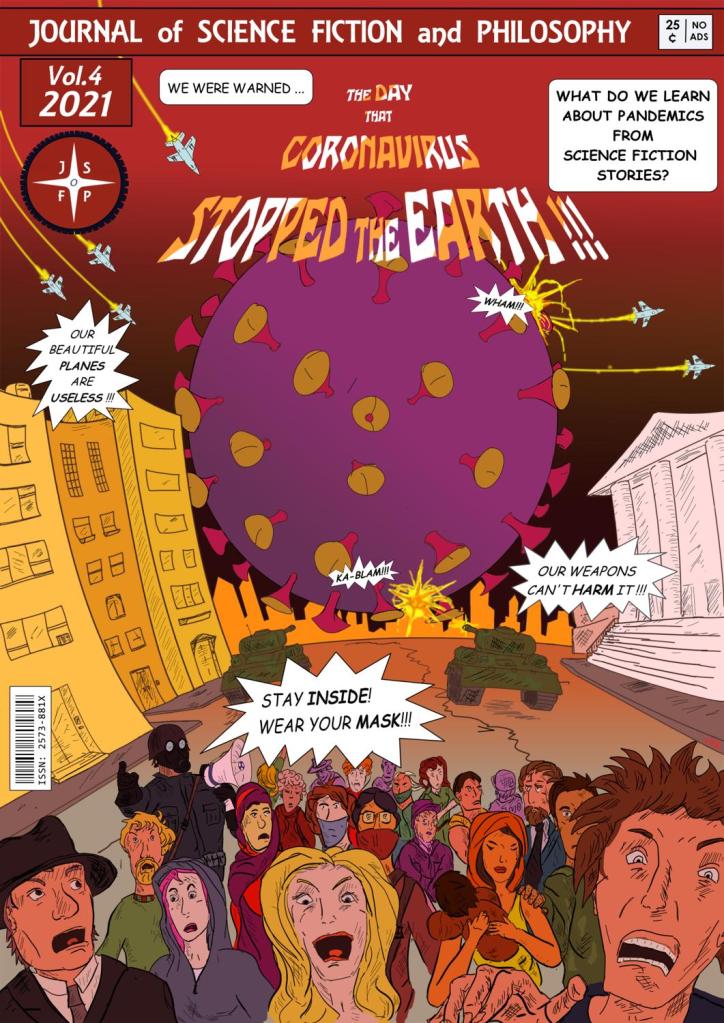
Issue: Vol 4 (2021): The Day that Coronavirus Stopped the Earth!
Section: Editorial Notes
Copyright (c) 2021, 2023, by Alfredo Mac Laughlin

This work is licensed under a Creative Commons Attribution-NonCommercial 4.0 International License.
Copyright for articles published in this journal is retained by the authors, with first publication rights granted to the journal. By submitting to this journal, you acknowledge that the work you submit has not been published before.
Articles and any other work submitted to this journal are published under an Attribution / Non-Commercial Creative Commons license; that is, by virtue of their appearance in this open access journal, articles are free to use – with proper attribution – in educational and other non-commercial settings.
There are no fees for authors publishing in the Journal.
 Journal of Science Fiction and Philosophy
You must be logged in to post a comment.